How do I check my electricity bill online in Pakistan?
Enter the 10–14 digit reference number from your last printed bill, choose the company that supplies you — MEPCO for Multan, LESCO for Lahore, and so on — and submit. The duplicate opens from the PITC portal, ready to read, print or save as a PDF. There is no account to create.
Can I check my electricity bill without a reference number?
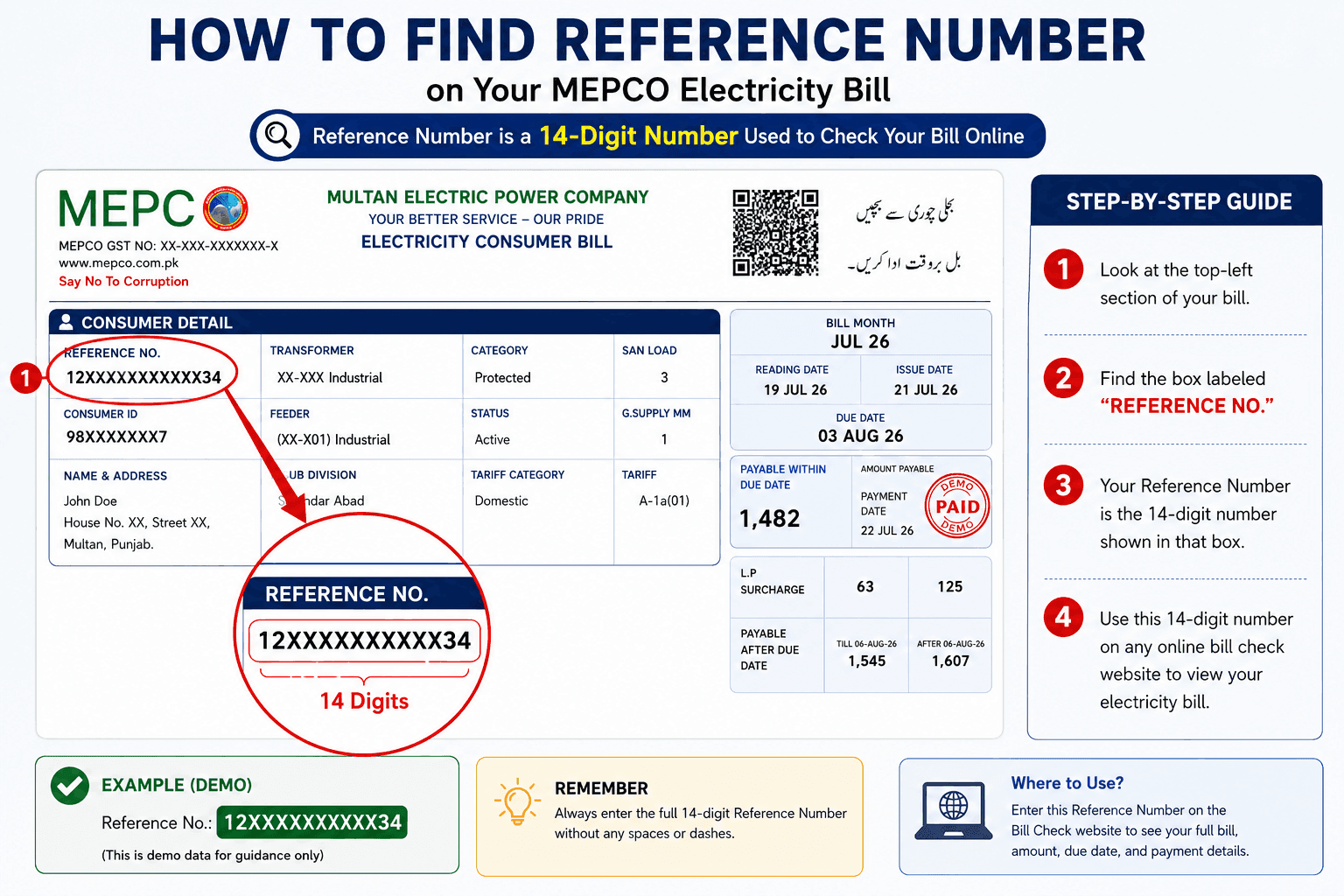
Not through PITC, and therefore not here — the lookup is built entirely around that number. You can recover it from any earlier bill, from your DISCO's billing SMS, or by calling customer care and verifying the account. It is 10 to 14 digits, printed under 'Reference No.' or 'Consumer Reference'.
Can I download and print my duplicate electricity bill?
Yes. Once the bill is on screen, print it the way you would any page — Ctrl+P on a computer, or the share/print item in your mobile browser's menu — and choose 'Save as PDF' if you want the file rather than paper.
Is Electricity Bill an official government website?
No. This is an independent tool that fetches your bill from the official PITC portal and shows it unaltered. We are not WAPDA, NEPRA, PITC or any DISCO. Anything touching your actual account — an outage, a disputed amount, a meter that looks wrong — has to go to your distribution company.
How fast does a bill check take?
Normally a few seconds. The limiting factor is PITC's own server, which gets slow around billing dates. If nothing comes back, re-read the digits against your printed bill before retrying — one wrong figure returns an empty result rather than an error.
Which electricity companies are supported on Electricity Bill?
All eleven DISCOs on the PITC platform: MEPCO (Multan and south Punjab), LESCO (Lahore), FESCO (Faisalabad), IESCO (Islamabad and Rawalpindi), GEPCO (Gujranwala), PESCO (Peshawar and KPK), HESCO (Hyderabad and lower Sindh), SEPCO (Sukkur and upper Sindh), QESCO (Quetta and Balochistan), TESCO (tribal districts) and HAZECO (Hazara and Abbottabad).
Does Electricity Bill support K-Electric (Karachi) bills?
No. K-Electric bills on its own system, entirely separate from PITC, so no reference number entered here would reach it. Karachi consumers use ke.com.pk with their 13-digit consumer number.
What is the difference between WAPDA and my DISCO?
Habit, mostly — people call any electricity bill a 'WAPDA bill'. In practice the document is issued by your distribution company: MEPCO, LESCO, FESCO or whichever serves your area. WAPDA sits above them as the parent authority, but the bill is a DISCO document produced through PITC.
What is FPA (Fuel Price Adjustment) on my electricity bill?
The monthly correction NEPRA applies for what generation actually cost — furnace oil, coal, imported LNG. It can add to the bill or, less often, credit it. FPA is the standard reason a bill moves while the units consumed stay flat.
Why is my electricity bill higher than usual?
Work through it in order: did the units go up (cooling in summer, heating in winter)? Did consumption cross a slab boundary, so the extra units cost more than the earlier ones? Was FPA positive this month? Are there arrears carried over, or a late surcharge? Comparing the units-consumed and FPA lines against last month's bill settles most cases in a minute.
What is a slab rate on my electricity bill?
A stepped price ladder. Each band of monthly units is charged at a higher rate than the band below, so the bill rises faster than consumption does. Staying at or under 200 units keeps a household in the protected, subsidised category — which is why watching your units matters more near a boundary than anywhere else.
What are peak hours and off-peak hours on my bill?
They apply only if you have a Time-of-Use meter. On one, roughly 7 PM to 11 PM is charged at the higher rate and everything else at the lower. Running the AC, iron or washing machine outside that window is where TOU consumers save. On a standard meter, timing makes no difference.
What is a protected vs unprotected consumer?
Protected means 200 units a month or fewer and NEPRA's subsidised slab rates. Above that you are unprotected and billed at the full rate, and the difference is significant. Your bill states which category applies to you.
Can I pay my electricity bill through Electricity Bill?
No — this site displays bills and does not handle payments. Take the reference number to JazzCash, Easypaisa, your bank app, an ATM or an authorised counter. That number is the only thing any of those channels needs.
How do I pay my electricity bill using JazzCash or Easypaisa?
Open the app, go to bill payment, select your DISCO, enter the reference number and check the amount against the bill before confirming. Without a smartphone, *786# runs the same flow over USSD. Keep the transaction ID until the payment appears on your next bill.
What is the difference between previous and current meter readings?
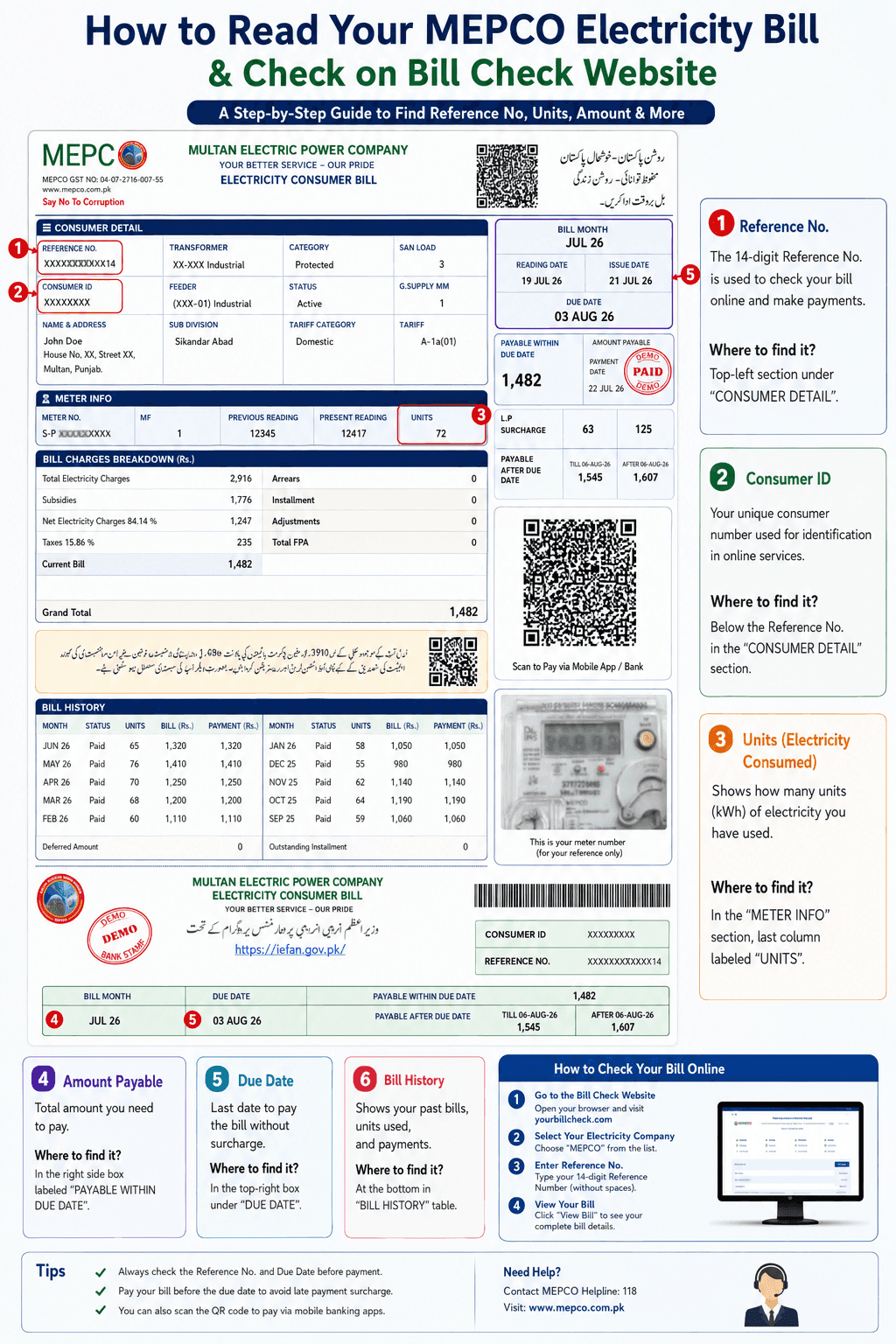
Both are printed on the bill. The gap between them, adjusted by any meter multiplier, is the units consumed for that cycle. If either figure looks wrong, that is a matter for your DISCO — we show what PITC returns and cannot amend a reading.
What is Late Payment Surcharge (LPS) on my bill?
The penalty applied once the due date passes. It is why the bill quotes two amounts — one payable in time, a higher one after. Pay against the first and the second never comes into play.
How do I save my duplicate bill as a PDF?
With the bill on screen, open your browser's print dialog (Ctrl+P, or the share menu on a phone) and pick 'Save as PDF' in place of a printer. The file is identical to what PITC produced, which is what banks, landlords and offices are usually asking to see.
Can I check bills for commercial or industrial connections?
Yes — the lookup is the same, provided you have that connection's reference number. What differs is the bill itself: commercial and industrial tariff categories (B-1, B-2, C-1, D-1) carry different rates and tax treatment from a domestic account.
I lost my old bill — how do I find my reference number?
Try in this order: billing SMS from your DISCO, payment receipts in JazzCash or Easypaisa, your bank's transaction history, then the subdivision office. Because the number belongs to the meter, an old receipt from years back is usually still valid.
How often is my electricity bill issued?
Monthly for most households, though the cycle can vary by area and account type. The billing month and issue date printed on the statement define exactly what period you are being charged for.
What is NEPRA and why does it affect my bill?
NEPRA is the national electricity regulator. It sets the slab structure and signs off the FPA, TRS and other mandated surcharges that appear on your bill, and it issues quarterly tariff determinations. When the rate changes without your usage changing, a NEPRA decision is usually behind it.
Who do I contact for outages, wrong readings, or billing disputes?
Your DISCO, on the helpline printed on the bill — MEPCO on 080066006, LESCO on 111-000-118, and so on. If the matter stalls there, PMDU and NEPRA's consumer complaint portal are the escalation routes. We have no access to account or metering records and cannot intervene.

 MEPCO Bill
 LESCO Bill
 FESCO Bill
 IESCO Bill
 PESCO Bill
 GEPCO Bill
 HESCO Bill
 QESCO Bill
 HAZECO Bill
 SEPCO Bill
 TESCO Bill